So I have been having fun recently with taking widefield images, both from my own back garden and during my recent holiday in the Cairngorms.
First up, I have an image of Ursa Minor aka The Little Dipper which I took using in the backgarden using my HEQ5 Mount enabling me to take reasonably long exposures.
To be honest, Ursa Minor is in quite an empty area of sky so my image isn't the most exciting but I still wanted to share it.
The image I took of Cassiopeia the same night is much more interesting as it is in a much busier section of the sky.
In this image I can actually make out several Deep Space Objects such as the Owl Cluster (NGC 457) and I am sure I can see the Pacman Nebula (NGC 281). I really love this image as I every time I study it I make out something I hadn't noticed before.
My next two images are both taken using a fixed tripod from the Cairngorms and capture different sections of the Milky Way.
I don't know if I can say much about these images but I really enjoyed getting the chance to get to see the Milky Way at a dark site although as the next picture of Orion shows it wasn't perfectly dark.
Here you can see Orion hanging over the village of Tomintoul which was producing some light pollution but it was still a wonderful place to see the night sky.
Friday, 20 November 2015
Wednesday, 11 November 2015
The Planets Line Up
So recently I was lucky enough to be up in the Cairngorms in Scotland when Jupiter, Mars and Venus all got very close to each other in the night sky. It took until my final morning there for the weather to be favourable and for me to get a chance to image it.
Whilst my wife though I was mad for getting up at 4.30am, the wide-field picture I took here shows that it really was a lovely view and I feel it was worth the early morning. As I was up I also decided to take a picture with the lens zoomed in a bit.
Friday, 30 October 2015
Sirsalis Rille & Crüger Crater
So it has been a while since I decided to spend any real time looking at the moon and recently I decided I would try and tackle a couple more of the Lunar 100.
I targeted two targets that were in the same area Sirsalis Rille (L77) & Crüger Crater (L52) and you can see the image I captured of them below.
Sirsalis Rille is a 426Km long lunar rille that starts at the edge of Oceanus Procellarum near Sirsalis crater from which it gets its name and proceeds directly away from the mare, eventually ending up among the cracks in the floor of Darwin crater. If you look closely around this area of the image you can also actually make Darwin Rille perpendicularly intercepting Sirsalis Rille.
I have put an image that I took with my 2x Barlow below which possibly shows the intersection a bit clearer.
Crüger Crater was pretty easy to see as it has a very dark interior floor which is actually one of the lowest albedo features on the Moon. The surface has been covered in basaltic lava and has only been exposed to a minimal amount of deposition from impact ejecta. The floor is nearly featureless, with only a tiny craterlet near the centre and few other even more diminutive impacts, none of which I could make out.
Friday, 2 October 2015
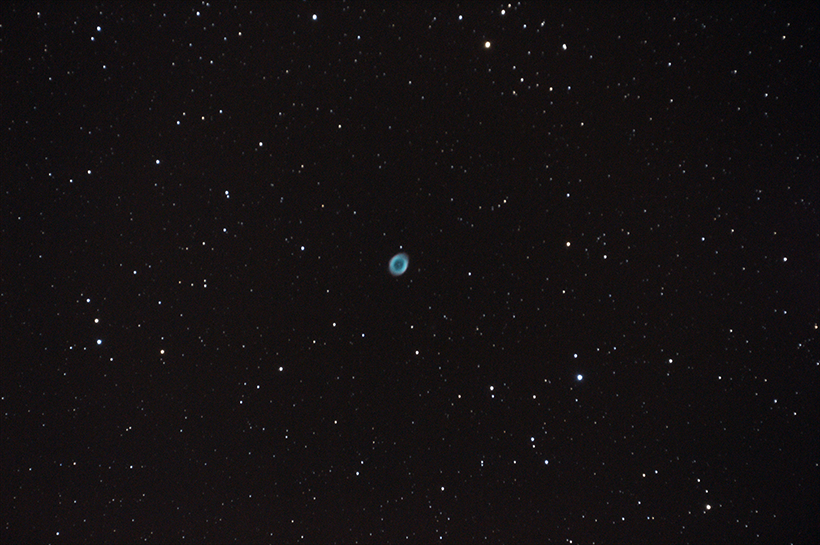
Ring Nebula (Messier 57) & the Great Globular Cluster in Hercules (Messier 13)
As any follower of this blog will know, I have recently started playing around with a HEQ5 mount and my DSLR camera. However, I also have been trying it with my 127 Mak telescope in addition to the standard Lenses.
Without guiding and due to the statistics of my telescope I am limited to bright, smaller targets and so I have recently decided to image the Ring Nebula & the Great Globular Cluster in Hercules. First up with the Ring Nebula in the constellation Lyra which is a stack of 10 x 90 second exposures.
I was pretty chuffed with this, especially considering my camera ran out of batteries before I could take any Dark or Flat frames. My unmodified camera does block the red elements of the nebula which is a shame but it is still a nice enough image.
Next up was the Great Globular Cluster in Hercules which is a stack of 16 x 75 second exposures. One thing I did this time was use Dark and Flat frames as I had remembered to charge my camera battery so I actually had time to do it.
I really like this image and think it shows that I am slowly learning how to use the camera and processing software. I do wonder how far I can go with my current setup and I now realise what people mean when they talk about how this hobby sucks the money out of you as there is always something better out there!
Tuesday, 29 September 2015
Super Moon Eclipse
In the early hours of September 28th there was a Super Moon Eclipse. The weather forecast for my area was terrible so I decided to just sleep through it. However, as luck would have it I woke up at 3.30am and had a quick look outside where I noticed that whilst it was quite hazy you could see the rust coloured moon as it sat there in the Earth's shadow.
I quickly grabbed my camera and took some pictures although I did struggle to get anything that clear due to the haze.
One thing I noticed which doesn't really come up well in the images is that it felt very eerie with the moon giving the night sky a red hue.
Saturday, 26 September 2015
Widefield Imaging with an Equatorial Mount
Since I bought my HEQ5 I have been waiting for the chance to try it out with my DSLR and so one clear night in early September I decided to finally test it out. I decided just to use my camera directly mounted with a standard 55-250mm Lens and aimed it at two of my favourites galaxies to look at, Messier 81 & 82.
I can actually make out two additional galaxies in the image, NGC 2976 & NGC 3077 although they are pretty much just small fuzzy patches. In order to show off the galaxies a bit more I cropped the image which is shown below.
A bit noisy but not unexpected at that level of crop, overall I am pretty happy with what I have achieved here and look forward to trying the DSRL with my 127 Mak next.
The image below is a stack of 15 x 120 second exposures which I was pretty chuffed with considering it was the first time I was properly testing my Polar Alignment skills and I didn't have any guidecam.
I can actually make out two additional galaxies in the image, NGC 2976 & NGC 3077 although they are pretty much just small fuzzy patches. In order to show off the galaxies a bit more I cropped the image which is shown below.
Monday, 7 September 2015
Perseid Meteors
So back in August, just as the Perseid Meteor shower was peaking the cloudy Scottish weather decided to clear. I didn't need much persuading but was soon in my car and heading off to a Harperrig reservoir to see what I could spot.
Quite simply it was superb as I must have seen more than 100 meteors although I didn't capture many of them on camera. I did at least capture a couple, one of which I have cropped and is shown below.
Not that exciting but it is nice to at least capture something and after capturing this one I decided it was time to try and image the Milky Way which was clearly visible in the sky.
It is a shame the light pollution in the bottom right corner detracts somewhat from the image but I am still quite proud of this as it is only one 30 second sub.
Subscribe to:
Posts (Atom)