Pages

Wednesday, 24 December 2014

A Year of Astronomy

So it is now a year since my parents bought me a Skywatcher 127 MAK for Christmas in 2013 and I have thoroughly enjoyed the late nights and amazing views it has brought me. As it is a year I thought I would have a look back over my current observation stats and see how well I am doing against some of the standard target lists.

Messier : 23 out of 110
Herschel 400 : 13 out of 400
Planets : 5 out of 7
Caldwell : 7 out of 109
Lunar 100 : 9 out of 100

Overall not bad for the first year although I suspect I will never complete the Caldwell list and many of them aren't actually visible from Scotland.

I have started some exploration into Astrophotography as well and am quite happy with several of the images I have taken even though I don't have the best of set-ups yet. Anyway, my favourites from the year are shown below.

Jupiter with Callisto, Io & Ganymede

Caldwell 13 / NGC 457 / The Owl Cluster

An Iridium Flare

Constellation Orion

Wednesday, 17 December 2014

Double Stars & A Little Bit More

Anyone reading this blog will know that I am slowly discovering the various double stars in Ursa Minor and this post details the next three stars in my adventure, STF 1958, STF 2134 & STF 2299. However, the same night that I observed these stars I also decided to explore a few other night sky objects such as the Garnet Star, Foxhead Cluster (NGC 6819), Caldwell 1 & NGC 7160. The locations of all these targets are shown below.


STF 1958 (SAO 16749)
RA: 15 29 24.12 Dec: +67 12 16.0
Magnitudes: 9.63, 9.97
Separation: 29.7”
Position Angle: 338°

The first of the double stars of the night and to be honest it wasn't that impressive with me not actually noticing the secondary star until I used averted vision even with the decent separation. As my night vision improved I managed to look at it directly but to be honest both the stars just looked a dim white colour.


STF 2134 (HIP 83092 / SAO 8679)
RA: 16 58 44.10 Dec: +76 06 33.0
Magnitudes: 9.43, 10.22
Separation: 45.8”
Position Angle: 144°

As my night vision was better by now I could see both the primary and secondary straight off without needing any averted vision, this was of course helped by the decent amount of separation. As with the previous double, both stars appeared white although the difference in magnitudes made for a greater level of contrast between them.


STF 2299 (SAO 2933)
RA: 17 38 55.61 Dec: +84 02 42.9
Magnitudes: 9.46, 9.67
Separation: 33.5”
Position Angle: 124°

My final double of the night and another uninspiring target with both stars once again coming across as white and easily separated. I appear to be at the bottom of the barrel when it comes to interesting doubles in Ursa Minor but I will keep going until I think I have reached the limit of my current scope.


Garnet Star / Mu Cephei (HIP 107259 / SAO 33693)
RA: 21 43 30.46 Dec: +58 46 48.17
Magnitude: 4.08

The Garnet Star is a red supergiant in the Cepheus constellation and is one of the largest and most luminous stars known in the Milky Way. Its name comes from the fact that it Herschel noted it had a Garnet Red colouring. I have to admit it is a lovely sight to look at which a lovely red colour that clearly comes through. After looking at plenty of white coloured doubles this evening it was nice to see something showing a bit of colour. It reminded me a little bit of the star La Superba in Canes Venatici which also has a clear red colouring.

NGC 6819 / Foxhead Cluster
RA: 19 41 18 Dec: +40 11 00
Type: Open Cluster
Magnitude: 7.3

NGC 6819 is located around 7,200 light years away in the Cygnus constellation. It is called the Foxhead Cluster because the brighter star form a triangular shape which is supposedly like the head of fox.

I have to admit that I struggled to see much from my back garden and I could make out maybe 4-5 stars at most which was very disappointing. However, even with this limited number of stars I could see that there was a vague "V" shape to them which helped confirm I was in the right location. Another interesting thing I noted was that surrounding this small cluster was another set of brighter stars which also formed a triangular shape.

Caldwell 1
RA: 00 48 Dec: +85 15
Type: Open Cluster
Magnitude: 8.1

Caldwell 1, also know as NGC 188 is an open cluster in the Cepheus constellation about 5,000 light years away. Unlike most open clusters that drift apart after a few million years because of the gravitational interaction of our galaxy, NGC 188 lies far above the plane of the galaxy and is one of the most ancient of open clusters known, at approximately 5 billion years old.

The light pollution from Grangemouth Oil Refinery to the North of my home meant there was a fair change I wouldn't see anything but I could still make out a barely perceivable patch of light in the sky. For this cluster I really need to use a bigger aperture although I might be able to get more from a darker site as well. Either way, the most disappointing of the night but this probably should have been expected given a 5 Inch telescope was always going to be pushing it due to low surface brightness etc.

NGC 7160
RA: 21 53 40 Dec: +62 36 12
Type: Open Cluster
Magnitude: 6.1

NGC 7160 is located around 2,600 light years away in the Cepheus constellation. This was probably my favourite Open Cluster of the night because it was pretty clear to see with about 9 stars being visible. The shape itself was quite interesting to behold and to me it looked almost like a tadpole.

It was quite a compact cluster so I am not sure how much more I would be able to resolve at a darker site but I still suspect I will be back to it in the future as it was quite nice to see.

Friday, 5 December 2014

Some Widefield Imaging of Andromeda

For Christmas I am getting a DSLR so I can make an attempt at really getting involved in astrophotography. I decided to search Ebay for some cheap prime lenses  in preparation for getting my hands on the camera and I came across an old Olympus Zuiko 50mm f/1.8 Lens which was only going to cost me about £6. At that price I couldn't resist it even if I did also have to pay another £3 for a converter so I could fit it to Canon DSLRs.


After it arrived I quickly borrowed a friend's camera and put it to work on an easy target, namely the Andromeda Galaxy (Messier 31). I basically took 10 x 8 seconds subs at ISO 1600 and then used DeepSkyStacker to stack them before undertaking a fair amount of processing work in Pixinsight & Photoshop. There was a lot of processing required as the image showed a lot of coma as I had the lens set to wide open and therefore I had to crop out a large chunk of the image and then try to remove the coma that remained. In the future I will probably need to step down the lens to get a wider view although this will reduce the amount of light I am capturing, I suppose an EQ mount of some sort will need to be procured at some point to help me extend the sub length. Anyway, despite this I am actually quite happy with the image I took which I have attached below.


My favourite aspect of the image is that you can actually make out M110 & M32 as well although they are rather small!

Monday, 17 November 2014

Back to Ursa Minor for Double Star Hunting

So my journey through the double stars of Ursa Minor continued recently on the 28th October when I observed and sketched three more stares. Those stars were 8 Ursae Minoris, STF 1761 & STF 1859 whose locations are shown below.


8 Ursae Minoris (HIP 73136 / SAO 8127)
RA: 14 56 48.35 Dec: +74 54 03.3
Magnitudes: 6.94, 8.92
Separation: 171”
Position Angle: 32°

So 8 Ursae Minoris was pretty easy to find with the bright star Kochab being very near. The primary and secondary were incredibly easy to spot as there is a large separation between them and they are more than bright enough for me to spot from my light polluted back garden. One thing I did enjoy about this double is that I actually picked up a very vague hint of yellow in the primary star and whilst I have tried to show it in my sketch it is probably very hard to see the difference between it and the other starts which looked white.

Another nice aspect of the view is  that variable star TT Umi is very close by towards the West of 8 Umi and has a lovely orange hue which I could clearly make out.


STF 1761 (HIP 66011 / SAO 7837)
RA: 13 32 01.67 Dec: +71 43 01.3
Magnitudes: 9.3, 10.1
Separation: 20.2”
Position Angle: 71°

The second double of the night was STF 1761 which was much fainter than 8 Umi but I was still able to make out both components. The sky wasn't the most transparent so it wasn't the easiest of views but it was obvious enough even if it was over shadowed by some of the brighter stars around it in the field of view. I couldn't pick out any colouring in the stars and it wasn't that interesting a view but at least it is another Ursa Minor double off the list.


STF 1859 (HIP 70783 / SAO 8027)
RA: 14 28 31.85 Dec: +73 03 18.3
Magnitudes: 8.63, 10.12
Separation: 19.8”
Position Angle: 234°

STF 1859 had a slightly brighter primary compared to STF 1761 which actually made it much easier to make out even if the secondary wasn't any different in magnitude. It was also much easier to focus in on it as the stars around it were not as overpowering in magnitude as I had seen with STF 1761. Once again though I still couldn't pick out any colour in the two components but I did enjoy watching them hover in the eyepiece.


Saturday, 4 October 2014

Single Exposure Astrophotography

So recently I decided once again to play around with a friend's Canon 1100d DSLR and my telescope to see what images I could capture. Unfortunately I had a couple of issues; I couldn't get the mount properly set up so star drift was bad and the clouds came across meaning I couldn't take more than a couple of .

However, thanks to the joys of Adobe Photoshop I was able to at least get something to show for my hard work. My first image was of Messier 13 also known as the Great Globular Cluster in Hercules.


This is basically just a single 30 second exposure taken at ISO 1600 and there was some pretty bad star trailing but I did some work to remove that. It does seem to be rather blue but it is obviously a Globular Cluster and I am curious to know what I could manage with multiple exposures and a better set up mount.

My second object I imaged is Messier 57 which is also known as the Ring Nebula.


This is an even weaker image than what I managed of Messier 13 as it is only a 15 second exposure and the star trailing was even worse. However, I was pretty happy about it as I just took the 15 second shot as a quick trial before the clouds came in and I suspect I can get much better in the future.

Tuesday, 23 September 2014

A Couple of Globular Clusters & The Dumbbell Nebula

For my most recent night outside with the telescope I dedicated to hunt down a few Messier objects I hadn't seen before which you can see detailed on the image below.


Messier 71
RA: 19 54 Dec: +18 47
Type: Globular Cluster
Magnitude: 7.1

Messier 71 is a Globular Cluster in the Sagitta Constellation and is a distance of around 12,000 light years away from Earth. For quite a while this cluster was actually dense open cluster due to it lacking a dense central region. However, further research has confirmed that it is actually a very loosely concentrated globular cluster, much like M68 in Hydra

To be honest, I really struggled to see this object in my telescope. It was very faint and it took a fair amount of time at the Eyepiece and some averted vision to bring out a very faint smudge of light. To be honest I was having issues of light pollution from my home as my wife kept switching on the lights which wasn't helping. I will need to take a further look at this globular cluster from a darker site at some point.

Messier 92
RA: 17 17 Dec: +43 08
Type: Globular Cluster
Magnitude: 6.4

After barely being able to see Messier 71 I decided to check out Messier 92 which was another Globular Cluster, this time in Hercules. This cluster is about 26,700 light-years away from Earth and is one of the oldest known Clusters.

My first interesting observation on this cluster was that it was much brighter than Messier 71 even though it is so much further away from Earth. It was very clear, compact and bright in the 32mm eyepiece with an obvious brightening towards its centre.

Messier 27 / The Dumbbell Nebula
RA: 20 00 Dec: +22 43
Type: Planetary Nebula
Magnitude: 7.5

My final target of the night was the Dumbbell Nebula, also known as the Apple Core Nebula or Messier 27. It is a planetary nebula in the constellation Vulpecula and is a distance of about 1,360 light years from Earth.

The GOTO on my mount was actually off by a little bit when I tried to find it but the nebula was actually visible in my finderscope so it was easy enough to centre it in my 32mm eyepiece. The moment I realised I could see it in the finderscope I knew I was going to be in for a treat and sure enough it was a lovely sight. I could clearly make out an hour glass shape and I am sure I even managed to pick up a hint of green colouring. I am actually a bit upset I left it to last as light cloud was affecting my view and I suspect I could have gotten a clearer view if I had looked at it earlier. It can join the ever growing list of objects that I want to look at again from a darker location.

Sunday, 21 September 2014

Clusters in Cassiopeia

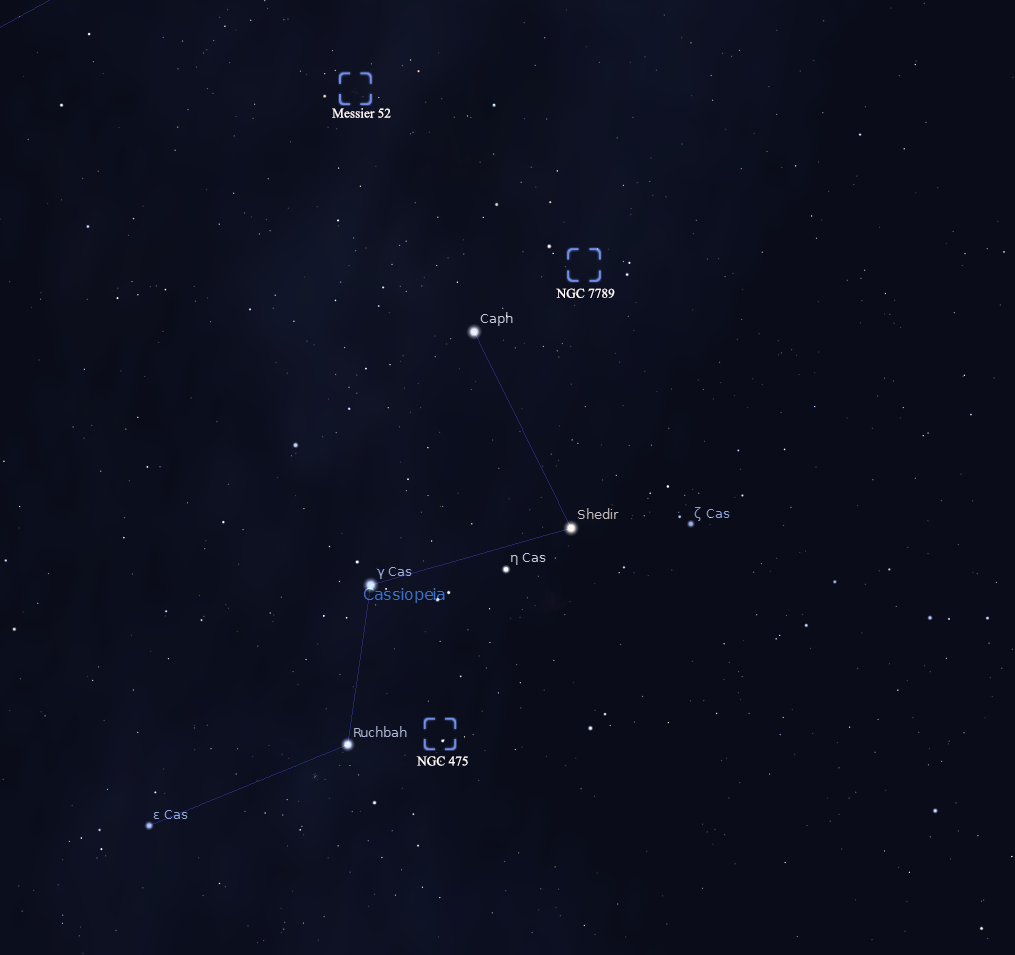
Cassiopeia has been a regular target for me since the late summer nights started getting dark enough for me to be out with my telescope. The constellation is full of clusters, several of which I have already mentioned in previous blog posts however there are others and I decided last night to try and see a couple more of them in addition to imaging my favourite of them all, NGC 457.


Messier 52
RA: 23 24  Dec: +61 35
Type: Open Cluster
Magnitude: 5

Messier 52 is an open cluster that is anywhere between 3,000 and 7,000 light years away and is comprised of at least 190 stars. I wasn't sure if it would be that easy to find this cluster as the brightest star has a magnitude of 11 but due the number of stars I actually saw it in my finderscope as a small hazy patch. Through the telescope it didn't initially look that special but once I used averted vision it became a lovely compact collection of faint stars. Even now 9 months since I started my astronomy adventure I find the power of averted vision to be quite amazing.

Supposedly the Bubble Nebula is less than a degree away from this cluster but I couldn't see it, then again from a light polluted back garden with my small telescope I didn't really expect to.

NGC 7789 / The White Rose Cluster
RA: 23 57  Dec: +56 43
Type: Open Cluster
Magnitude: 6.7

The White Rose Cluster is an open cluster that is approximately 8,000 light years away and was actually discovered by William Herschel's sister, Caroline. The name is because when viewed visually the loops of stars and dark lanes supposedly look like the swirling pattern of rose petals. Personally, I don't see what the heck people are talking about as to me it just looked like a plain old cluster of stars but I may need to take a look at it from a dark site in the future to see if that was the issue.

NGC 457 / Caldwell 13 / The Owl Cluster
RA: 01 20 Dec: +58 17
Type: Open Star Cluster
Magnitude: 6.4

I have discussed NGC 457 previously when I detailed my visual observations but to recap it is an Open Cluster about 9,000 Light Years away and is comprised of about 200 stars in a region 30 light years wide. It does have a beautiful shape and I was therefore determined to try and get an image of it to share with you all. Amazingly enough I think I did a pretty good job considering the limitations of my set up but feel free to make up your own mind on how good a job I have done.