Pages

Saturday, 7 January 2017

Mercury Solar Transit

So it has been ages since I posted on here, mainly because I hadn't actually had my gear out much since the last post. However, I did use it during the Mercury Transit and I have no excuse for not posting about that!

I am therefore going to try and cover it now, many months later!

Firstly, I was amazed that on the morning of the 9th May 2016 I got up and found the Scottish sky was clear and the sun was shining. This was great news to me as I had already spent the day before designing a Solar Filter to fit over my Skywatcher 80ED in the hope of catching the Transit of Mercury. If I had missed it then it would have been 2019 before I got another chance.

Anyway I took some shots with my Canon 700d and with my QHY5II-L Planetary camera. First up however, I may as well show you a cropped image of Mercury's first moment of transit.


I actually took quite a lot of images over the first hour and even managed to make a short film out of it!


It is a shame the image is so small as it isn't always that easy to spot the tiny wee planet crossing the solar disc but that I suppose is part of the charm. To make it easier to spot, I actually took a picture and annotated it which is something I don't normally do, but some of my non astro friends on facebook needed it pointed out to them!


One of my favourite images though was the one I took with my planetary webcam, mainly because I got a bigger image of Mercury, but also because it really brought out the sunspots as well.


It was a thoroughly enjoyable day for me and of course I couldn't do some solar imaging without a little solar projection which was useful when my kids came home from school!


It isn't easy to see but Mercury is there a tiny dark spot. What I don't have pictures of however is the point at which I left a cap on my eyepiece and took the filter off which resulted in a little bit of smoking, nor am I am showing you images of the terrible sun burn I got!

Either way it was a fun afternoon and I am glad the Scottish weather actually let me see it!


Saturday, 30 April 2016

Messier 42 (Orion Nebula) - Everyone's Favourite Nebula!

I think everyone loves Messier 42 also known as the Orion Nebula. Visual astronomers are treated to a lovely view in the eyepiece of even the smallest telescope and for astrophotographers it offers a wonderful bright and colourful target.

One evening I was trying to take images of various targets with my 80ED scope and didn't really get anywhere so in a last throw of the dice I decided to take a few exposures of the Orion Nebula. I set my camera to ISO 800 and ended up with 16 x 90 second usable images.

Whilst my image taking was a rather quick and messy process as I hadn't planned to image the nebula, my processing was not. I read up all sort of guides to try and work out how best to bring out the nebula in all its glory. I wanted to try and capture some of the fainter dust clouds but also didn't want to over expose the core. The result all several hours of processing work is below and for a first attempt I am incredibly proud of it.


Saturday, 19 March 2016

A Couple of Clusters

I haven't yet had the courage to try and undertake guiding with my new astro-imaging set up so I tend to limit myself to exposures of 2 minutes or less. This means I lack the confidence to try and image some of the really faint objects in the skies and tend to limit myself to the more obvious clusters etc. Recently I spent a night trying to image two such clusters, the first of these is the famous Double Cluster in Perseus. Also know as Caldwell 14 or NGC 869 and NGC 884, this naked-eye open cluster is a regular target for visual astronomy due to how wonderful it looks in a wide field eyepiece.

I have to admit I didn't spend that long imaging it because I had decided I would spend more time on it when I get a Field Flattener but I did manage to still get 27 x 90 Second exposures at ISO 800.


The lack of Field Flattener has caused some distortion around the edge of the image but the cluster itself is quite well defined. The camera has actually picked up a fair bit more colour than I have ever managed to see visually which was nice to see.

The next open cluster of the night was one which is a little less known, The 37 Cluster (NGC 2169) in Orion. What I really loved about this cluster is that when I had previously looked at it visually it actually looked like its name.

The image I ended up with is composed of 15 x 90 second exposures at ISO 800.


The image has been cropped a fair bit to increase the size of the cluster in the image, although now I can't decide if I prefer the original wider field.

Wednesday, 27 January 2016

First Light with the Sky-Watcher 80ED Pro

So only a few days after moaning about the bad weather, we actually had a couple of nights with clear skies. It was also about -5ยบC across the two days so I felt a little bit cold when I was out trying to use my new Telescope and Camera.

As it was my first night out I decided to be boring and pick everyone's favourite target, M31, aka the Andromeda Galaxy.

So after setting everything up and getting on target (which took about 2 hours) I was ready to start imaging! I basically took 16 x 90 second subs at ISO 800. I failed to get any Darks or Lights as I was beginning to feel the cold and just didn't have the dedication to stick it out any longer.

I processed the image in Photoshop and whilst I know I lost a bit of data in the processing, I am happy enough with this first attempt.


You may notice there are some issues with the focus on the stars along the left hand side of the image. This is because I believe I had some issues in the optical train which resulted in my DSLR sensor not being square to the optical path. The reason was that I struggled to get focus so ended up setting up a very badly held together "botch" job.

Since taking this image however I have found a little extension tube in my telescope case which states "DSLR Adaptor" rather obviously on the side of it. This would have given me a much more firm extension system to help achieve focus. I probably should have checked it out first but I was just a bit keen!


Wednesday, 20 January 2016

New Equipment = Terrible Weather

So for Christmas I got some new Astronomy gear to play around with. I got permanent control of the Modified Canon 700D DSLR I had played with previously which is basically a Canon 700D with the IR filter removed to increase the sensor response to red light.

In addition, I also got a Sky-Watcher Evostar 80ED DS-Pro Telescope. This scope is a Apochromatic refractor which will provide me with a much wider field of view than my 127 Mak.


In addition to the wider field of view it is also a "faster" scope meaning that more light will get to my camera during an exposure than would do on the Mak.

For anyone out there who likes the official specs then here they are:

Diameter: 80mm
Focal Length: 600mm
F/ratio: F/7.5
Fully Multi-Coated Doublet Objective Lens
FPL-53 ED Fluorite Glass Objective Element
Backlash-free 2” Crayford Focuser

Now all I need is the chance to use it!

Thursday, 24 December 2015

Trials with a Modified DSLR - The Heart Nebula IC1805

So I am a lucky man and am going to get a Modified Canon 700D DSLR for Christmas. Basically the modification removes an IR filter from the camera which increases the amount of red light now getting through to the sensor.

However, I needed to test it when it was received and was allowed one night to play around with it in the back garden to make sure it worked.

I decided to pick a target that my standard DSLR would struggle to pick up from my back garden with only a couple of minutes of exposure. The target chosen was the Heart Nebula also known as IC 1805 and the image I took is a stack of 8 x 120s Exposures at ISO 1600 using a Canon 55-250mm IS STM Lens.


I am really chuffed with this considering the Lens I used isn't the best and I had to do a lot of processing to remove light pollution. The heart shape is still visible and hopefully once I get a Light Pollution Filter I can get something even better.

The Camera is now packed away for Christmas Day but I am looking forward to getting more time using it in the future.

Friday, 20 November 2015

Widefield Fun

So I have been having fun recently with taking widefield images, both from my own back garden and during my recent holiday in the Cairngorms.

First up, I have an image of Ursa Minor aka The Little Dipper which I took using in the backgarden using my HEQ5 Mount enabling me to take reasonably long exposures.


To be honest, Ursa Minor is in quite an empty area of sky so my image isn't the most exciting but I still wanted to share it.

The image I took of Cassiopeia the same night is much more interesting as it is in a much busier section of the sky.


In this image I can actually make out several Deep Space Objects such as the Owl Cluster (NGC 457) and I am sure I can see the Pacman Nebula (NGC 281). I really love this image as I every time I study it I make out something I hadn't noticed before.

My next two images are both taken using a fixed tripod from the Cairngorms and capture different sections of the Milky Way.


I don't know if I can say much about these images but I really enjoyed getting the chance to get to see the Milky Way at a dark site although as the next picture of Orion shows it wasn't perfectly dark.


Here you can see Orion hanging over the village of Tomintoul which was producing some light pollution but it was still a wonderful place to see the night sky.

Wednesday, 11 November 2015

The Planets Line Up

So recently I was lucky enough to be up in the Cairngorms in Scotland when Jupiter, Mars and Venus all got very close to each other in the night sky. It took until my final morning there for the weather to be favourable and for me to get a chance to image it.


Whilst my wife though I was mad for getting up at 4.30am, the wide-field picture I took here shows that it really was a lovely view and I feel it was worth the early morning.  As I was up I also decided to take a picture with the lens zoomed in a bit.


Friday, 30 October 2015

Sirsalis Rille & Crรผger Crater

So it has been a while since I decided to spend any real time looking at the moon and recently I decided I would try and tackle a couple more of the Lunar 100.

I targeted two targets that were in the same area Sirsalis Rille (L77) & Crรผger Crater (L52) and you can see the image I captured of them below.


Sirsalis Rille is a 426Km long lunar rille that starts at the edge of Oceanus Procellarum near Sirsalis  crater from which it gets its name and proceeds directly away from the mare, eventually ending up among the cracks in the floor of Darwin crater. If you look closely around this area of the image you can also actually make Darwin Rille perpendicularly intercepting Sirsalis Rille.

I have put an image that I took with my 2x Barlow below which possibly shows the intersection a bit clearer.


Crรผger Crater was pretty easy to see as it has a very dark interior floor which is actually one of the lowest albedo features on the Moon. The surface has been covered in basaltic lava and has only been exposed to a minimal amount of deposition from impact ejecta. The floor is nearly featureless, with only a tiny craterlet near the centre and few other even more diminutive impacts, none of which I could make out.

Friday, 2 October 2015

Ring Nebula (Messier 57) & the Great Globular Cluster in Hercules (Messier 13)

As any follower of this blog will know, I have recently started playing around with a HEQ5 mount and my DSLR camera. However, I also have been trying it with my 127 Mak telescope in addition to the standard Lenses.

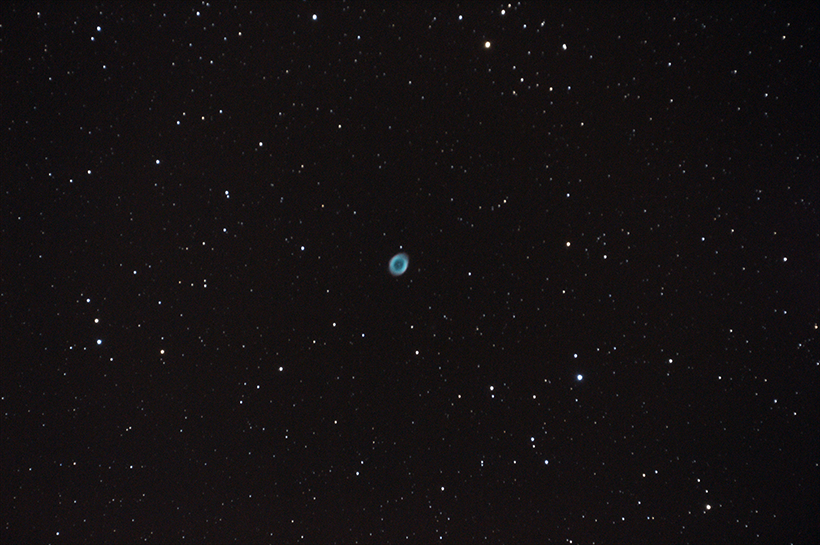
Without guiding and due to the statistics of my telescope I am limited to bright, smaller targets and so I have recently decided to image the Ring Nebula & the Great Globular Cluster in Hercules. First up with the Ring Nebula in the constellation Lyra which is a stack of 10 x 90 second exposures.


I was pretty chuffed with this, especially considering my camera ran out of batteries before I could take any Dark or Flat frames. My unmodified camera does block the red elements of the nebula which is a shame but it is still a nice enough image.

Next up was the Great Globular Cluster in Hercules which is a stack of 16 x 75 second exposures. One thing I did this time was use Dark and Flat frames as I had remembered to charge my camera battery so I actually had time to do it.


I really like this image and think it shows that I am slowly learning how to use the camera and processing software. I do wonder how far I can go with my current setup and I now realise what people mean when they talk about how this hobby sucks the money out of you as there is always something better out there!

Tuesday, 29 September 2015

Super Moon Eclipse

In the early hours of September 28th there was a Super Moon Eclipse. The weather forecast for my area was terrible so I decided to just sleep through it. However, as luck would have it I woke up at 3.30am and had a quick look outside where I noticed that whilst it was quite hazy you could see the rust coloured moon as it sat there in the Earth's shadow.

I quickly grabbed my camera and took some pictures although I did struggle to get anything that clear due to the haze.


One thing I noticed which doesn't really come up well in the images is that it felt very eerie with the moon giving the night sky a red hue.

Saturday, 26 September 2015

Widefield Imaging with an Equatorial Mount

Since I bought my HEQ5 I have been waiting for the chance to try it out with my DSLR and so one clear night in early September I decided to finally test it out. I decided just to use my camera directly mounted with a standard 55-250mm Lens and aimed it at two of my favourites galaxies to look at, Messier 81 & 82.

The image below is a stack of 15 x 120 second exposures which I was pretty chuffed with considering it was the first time I was properly testing my Polar Alignment skills and I didn't have any guidecam.


I can actually make out two additional galaxies in the image, NGC 2976 & NGC 3077 although they are pretty much just small fuzzy patches. In order to show off the galaxies a bit more I cropped the image which is shown below.


A bit noisy but not unexpected at that level of crop, overall I am pretty happy with what I have achieved here and look forward to trying the DSRL with my 127 Mak next.

Monday, 7 September 2015

Perseid Meteors

So back in August, just as the Perseid Meteor shower was peaking the cloudy Scottish weather decided to clear. I didn't need much persuading but was soon in my car and heading off to a Harperrig reservoir to see what I could spot.

Quite simply it was superb as I must have seen more than 100 meteors although I didn't capture many of them on camera. I did at least capture a couple, one of which I have cropped and is shown below.


Not that exciting but it is nice to at least capture something and after capturing this one I decided it was time to try and image the Milky Way which was clearly visible in the sky.


It is a shame the light pollution in the bottom right corner detracts somewhat from the image but I am still quite proud of this as it is only one 30 second sub.

Thursday, 30 July 2015

The Phases of Venus

So Summer has been with us for a bit now although if you live in Scotland like me I am sure you will agree that it hasn't been much of a Summer. Summer has hampered my ability to use my telescope but I have been trying to capture the odd image of Venus when the sun has set far enough to let this planet appear in the dusk sky.

The reason I was trying to capture images of Venus is that I was hoping to share the way in which Venus changes as the months pass. It isn't the most exciting plant to look at but the changes in phase and size are quite brilliant to see.


Hopefully you will agree with me that it is quite brilliant. To be honest, I was struggling when I took the July image because Venus was so low in the sky and I had to try and set my scope up in the bedroom so I could capture it. Either way it is still good enough and continues to show the changes that the planet goes through. Unfortunately I have not been able to capture anything else but I am still happy enough.

Wednesday, 20 May 2015

My New Mount - Skywatcher HEQ5

Anyone, that has read some of my previous posts will know that I sometimes comment on the fact I use "incorrect" equipment for DSLR astrophotography. My main gripe being my mount which isn't very stable, suffers from field rotation and doesn't have the best motors. Basically it is rubbish for astrophotography and I really needed something different.

I have had my eyes on a Skywatcher HEQ5 for quite a while as it seems to be a common choice for astrophotography use and it isn't as heavy as some of the bigger mounts like the NEQ6. My version of choice was the HEQ5 Syntrek which is basically the HEQ5 Pro SynScan without the GOTO handset. I basically didn't need the handset as I already have one with my Alt-Az mount plus I plan to use a laptop in the future when using the mount for astrophotography.


However, when looking at some online sites I noticed that there was comments about the Syntrek version being discontinued which horrified me as I didn't want to pay circa £130 more for a handset I didn't need! This meant that my planned Christmas present was now a May Bank Holiday present and I quickly snapped up the last one. After buying it, the mount was actually deleted from First Light Optics' website within 15 minutes!

I have had lots of fun in the kitchen already with it including attaching it to the laptop and controlling it with an Xbox 360 gamepad. All I need now is a nice clear night to really test it out including an attempt at some long exposure photography.

Monday, 18 May 2015

Mercury

In April, Mercury appeared in our sky at a point where I was actually able to observe it for at least 30 minutes each night. I was pretty chuffed to see it as it meant that I had now been able to observe all the planets in the Solar System. However, I decided that I wanted to try and capture an image of it as well.

First up with a widefield shot which was pretty easy to capture. I actually have several now but the picture I took at Harperrig is my favourite and that is they one I am including in this blog post.


The colour of the sky due to the setting sun is wonderful as it is, but seeing Mercury shining near the horizon just adds to the image in my opinion.

Of course, I also had to try and capture the planet with my telescope, which wasn't as easy due to the lack of alignment stars. There was a fair bit a manual intervention involved in getting the telescope on target but I managed it, even if I only had about 15 minutes of time to then capture something.


To be honest, it isn't very good. The atmospheric disturbance was terrible due to how low in the horizon Mercury is and I struggled to even capture what I did. One nice thing is that you can tell the planet has a slight phase as it isn't exactly circular in shape but beyond that I can't say it is that interesting.

Friday, 15 May 2015

Recent Photography Fun at Harperrig Reservoir

So, over the last couple of months as the evenings grew longer I have tried to get along to Harperrig Reservoir as much as possible. Whilst I do use my telescope for visual astronomy I have also been leaving my DSLR set up on a fixed tripod taking the odd image. I wanted to share two of them with everyone here as I like both of them.

The first is one image from the several hundred that I took on the night that the Lyrid meteor shower peaked. This is the one meteor I actually captured with the camera, I saw quite a lot that night but none of them wanted to occur in my camera's field of view. In fact the rather weak meteor I did capture was the last image I took that night so it was pretty lucky that I caught anything.


Next up is a Star Trail image I took on another night by taking 93 x 30 second exposures and then merging them together. I managed to get Polaris pretty close to the centre of the image which was a nice bonus. In the future I hope that I can maybe get some star trails with fixed scenery as they tend to make the nicest images.


I took a lot more images over the night of late Spring but the two above are my favourite. I now need to try and improve on them in future sessions.

Monday, 20 April 2015

More Astrophotography Fun with all the Wrong Equipment

As I have alluded to in the past, my set up is far from optimum when it comes to trying to image Deep Space Objects. However, ever so often I like to have the odd play and see what I can get. Recently I had one of those moments and spent some time imaging a couple of Messier objects, Messier 34 and Messier 42.

First up was Messier 34 also know as the Spiral Cluster which is an open cluster in the constellation Perseus. I only managed to get 10 second exposures before the unstable mount caused me issues but in the end I managed to stack 21 of them together to capture the following image.


I have to be honest and say it isn't that inspiring, I still don't really get why it is known as the spiral cluster and the low exposure time and high F ratio means I didn't pick up many of the dimmer stars.

After this I moved onto everyone's favourite, Messier 42 also known as the Orion Nebula. This wonderful nebula within the Orion constellation is wonderful with visual astronomy so even with the limited exposure length I knew I would at least get something although a lack of stars meant my stacking programme wouldn't stack more than 9 images together.


I couldn't pick up the huge amount of the dust clouds present in the nebula but I did there is still a fair amount and the colours look lovely!

Saturday, 18 April 2015

Jupiter GRS

So since I started my astronomy hobby I have never managed to get a very clear image of Jupiter's Giant Red Spot. So when I found out that it was going to be right in the middle at a decent time for me I set myself up and went imaging!


As you can see I clearly captured my target, but this just made me desperate for more. I decided it was time to try the barlow again!

For anyone who has read my blog before, you will know that I have never managed to get a decent image via barlow. However, I ended up doing some research and discovered that the relationship between my planetary camera pixel size and telescope focal ratio meant wasn't optimum for using my new 2.5x barlow. I therefore looked out my old 2x barlow and captured the image below.


Wow! It finally worked! I now know that for the time being I am going to bring my old 2x barlow out of retirement and use it on other targets to see if I can up the magnification.

Monday, 23 March 2015

A Partial Solar Eclipse

So on the morning of 20th March 2015 a partial Solar eclipse passed across the United Kingdom and I decided I wanted to see it. I had missed the last one in 1999 due to cloud cover but this time I was determined, especially as it was going to be 93% covered in East Central Scotland.

The weather forecast was terrible to be honest but via searching the internet weather reports I identified Arbroath as a potential candidate site for clear skies and headed there where I met a fellow Astronomer called Iain from the Central Scotland Observer's Group. Unfortunately upon arrival we found clouds, but a quick look to the West made us realise that the city of Dundee might be a better place and so we hopped back in our cars and headed there.

This proved to be a great idea as we arrived in Dundee to find clear skies although we had missed the first 15 minutes of the event as my first photo can attest to.


So as we stood photographing the sun and adjusting our tripods we were soon greeted by the many locals of Dundee who wished to have look through our collection of Eclipse glasses. We were of course happy to oblige and Iain took a picture of me with one pleasant chap in a motability scooter.


Anyway, the prime point in the eclipse was when the sun was at its most covered which was around 9.35am with the sun appearing to look like a big smile.


Of course viewing the sun through glasses and cameras wasn't our only bit of fun! Iain had brought his binoculars and using a piece of card we managed to get a nice projection image to show various people who passed by.


Time passed and before we knew it the Moon was slowly moving completely away from the sun's disc but I managed to get a picture of the last moments of the eclipse.


Overall, it was a very enjoyable morning spent appreciating a wonderful sight. Anyway, I ended up making a timelapse movie of the images I took which is viewable below.